There are a great many places to learn an instrument in Kuala Lumpur, and from the outside they present almost identically — a photograph of a piano, a list of instruments, a form. Parents end up comparing the two things that are easy to compare: how much it costs and how far it is.
Those matter. But they are rarely what a family is unhappy about twelve months later. These nine questions get at the rest, and every one of them can be asked in a single phone call or a trial visit.
- What qualifications does the teacher who will actually teach my child hold?
- Will we have the same teacher every week?
- Is the lesson one-to-one, and will it stay that way?
- How long is a lesson, and how is that time structured?
- How often do students perform, and where?
- What is the school’s position on grade examinations?
- What happens when we are ill or away?
- Can we try a lesson before committing?
- Who do I talk to when something is not working?
Who will actually teach your child
At Virtuoso Élite every teacher holds a degree in music at minimum, and some hold doctorates. We are deliberate about that floor, and it is worth explaining why.
Playing an instrument well and understanding music are not the same accomplishment. Someone with years of experience, or a Grade 8 certificate on one instrument, has proved they can play that instrument — a real achievement, and not the one that matters most in a lesson. Understanding music means knowing how a piece is built, why a phrase resolves the way it does, and where a student’s difficulty is actually coming from when the obvious fix does not work. That is what a degree teaches, and it is the difference between a teacher who can demonstrate a passage and one who can explain it.
What happens in the room
Every lesson here is one-to-one, and the reason is not exclusivity — it is that the format decides who the lesson is pitched at. One-to-one means the pace, the repertoire and every correction are matched to one student, and a technical fault gets caught in the week it appears rather than several months later. It is simply what does the most for serious progress.
Ask how a lesson is structured, too. A good answer sounds specific — warm-up, technical work, current repertoire, something new — and a vague one usually means the lesson is improvised around whatever the student brings. Improvisation has its place; it should not be the whole plan.
Grade 8 on one instrument proves someone can play it. It does not prove they understand music.
Where the year is heading
A school without performances is a school where nothing is ever quite finished. Practice runs indefinitely, standards drift, and the student never learns what it feels like to be ready. Ask how often students perform and where — in a studio for parents, or on a real stage.
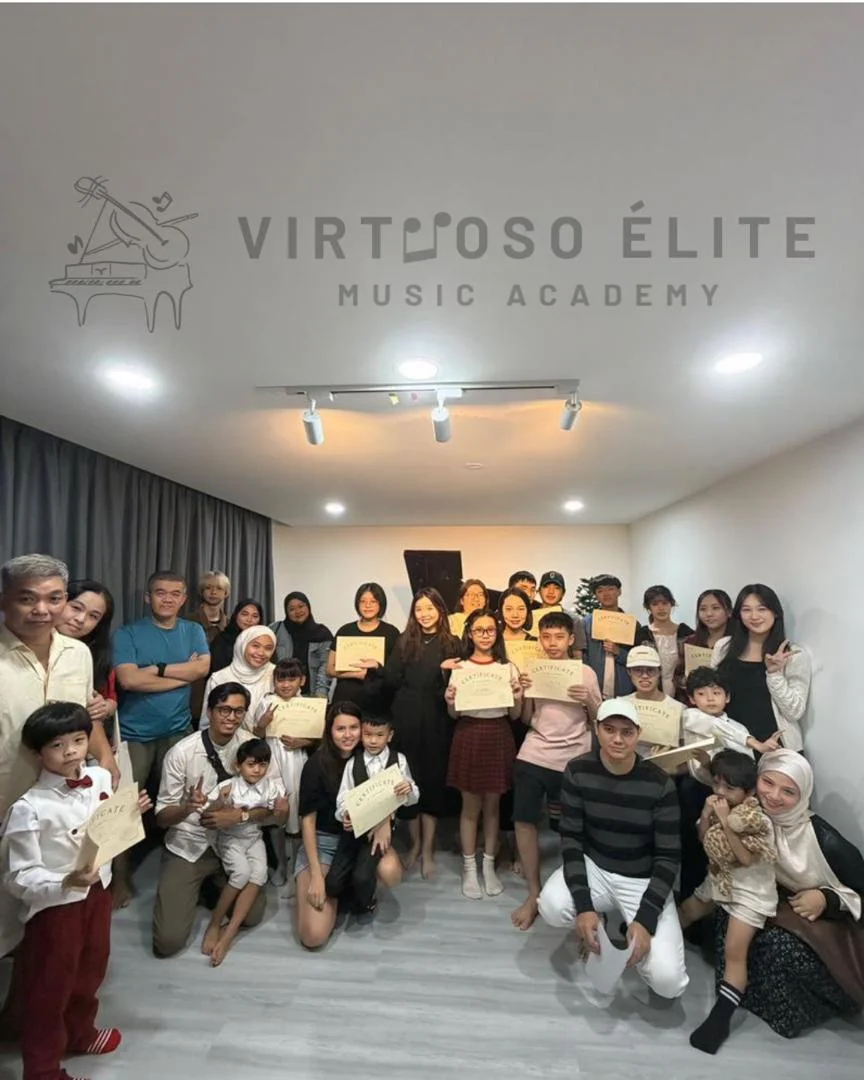
Our calendar is built around the recital: every three months, students at every level perform, at the academy itself and at external venues, and every performer leaves with a VEMA Certificate of Completion. In the last six months more than forty-five students have played. It is the moment the lessons turn into music.
Grades deserve a question of their own, and the right answer depends entirely on what you want. If you need a certificate for a school application, ask directly whether the school prepares candidates and for which board. ABRSM and Trinity examination preparation is coming soon at the academy. Our position on grades is unchanged: students may sit them when the time is right, but the goal is musicianship — not a certificate.
A trial lesson is thirty minutes, one-to-one, at Pandan Indah or Damai Perdana — and a good chance to ask everything above in person. Trial lesson fees apply.
Book a Trial LessonThe practical things nobody asks until later
These questions feel small at enrolment and large in month four.
Ask what happens to a missed lesson before you need the answer. Every school handles it differently, and finding out mid-fever is the wrong time.
Classes run weekly — a minimum of forty-five a year, setting aside public holidays and the academy's own break. Traffic between Cheras and Ampang at six on a weekday is a real factor — pick the branch you will still be happy driving to a year from now.
Ask what instrument the student needs at home and when. A teacher who tells you to wait before buying anything is giving you better advice than one who does not.
When something is not working — a personality mismatch, a plateau — you want to know there is someone to raise it with, and that changing teacher is a normal request rather than an insult.
Try before you commit
Everything above is research. A trial lesson is evidence. Thirty minutes, one-to-one with the teacher, tells you more than any amount of comparing websites: whether the room is calm, whether the teacher talks to your child or about them, and whether anything musical happened in the first ten minutes.
We run trials at both branches — Pandan Indah, which is the easier trip from Ampang and Taman Maluri, and Damai Perdana in Cheras, which suits families nearer Bandar Tun Razak. Trial lesson fees apply, and we will match you with a teacher and reply on WhatsApp within a working day.
Bring the nine questions. A school that welcomes them is usually the one worth choosing.
Frequently asked questions
A music degree is a reasonable floor for a school that teaches to an advanced level. Experience alone is not the same thing: a Grade 8 certificate proves someone can play one instrument, not that they understand how music works or how to teach it. Every teacher at Virtuoso Élite holds a degree in music at minimum, and some hold doctorates.
Because the format decides who the lesson is pitched at. One-to-one means the pace, the repertoire and every correction are matched to one student rather than averaged across a room — simply the format that does the most for serious progress. Every lesson at Virtuoso Élite is one-to-one.
Only if grades are what you want. Examinations are one way to structure progress, not the only one, and plenty of excellent musicians never sat one. ABRSM and Trinity examination preparation is coming soon at the academy; our position is that students may sit them when the time is right, but the goal is musicianship, not a certificate.
More important than most parents expect. Performing converts private practice into something public and finished, and it is where nerves get trained. Our calendar is built around a recital every three months, and every performer receives a VEMA Certificate of Completion.