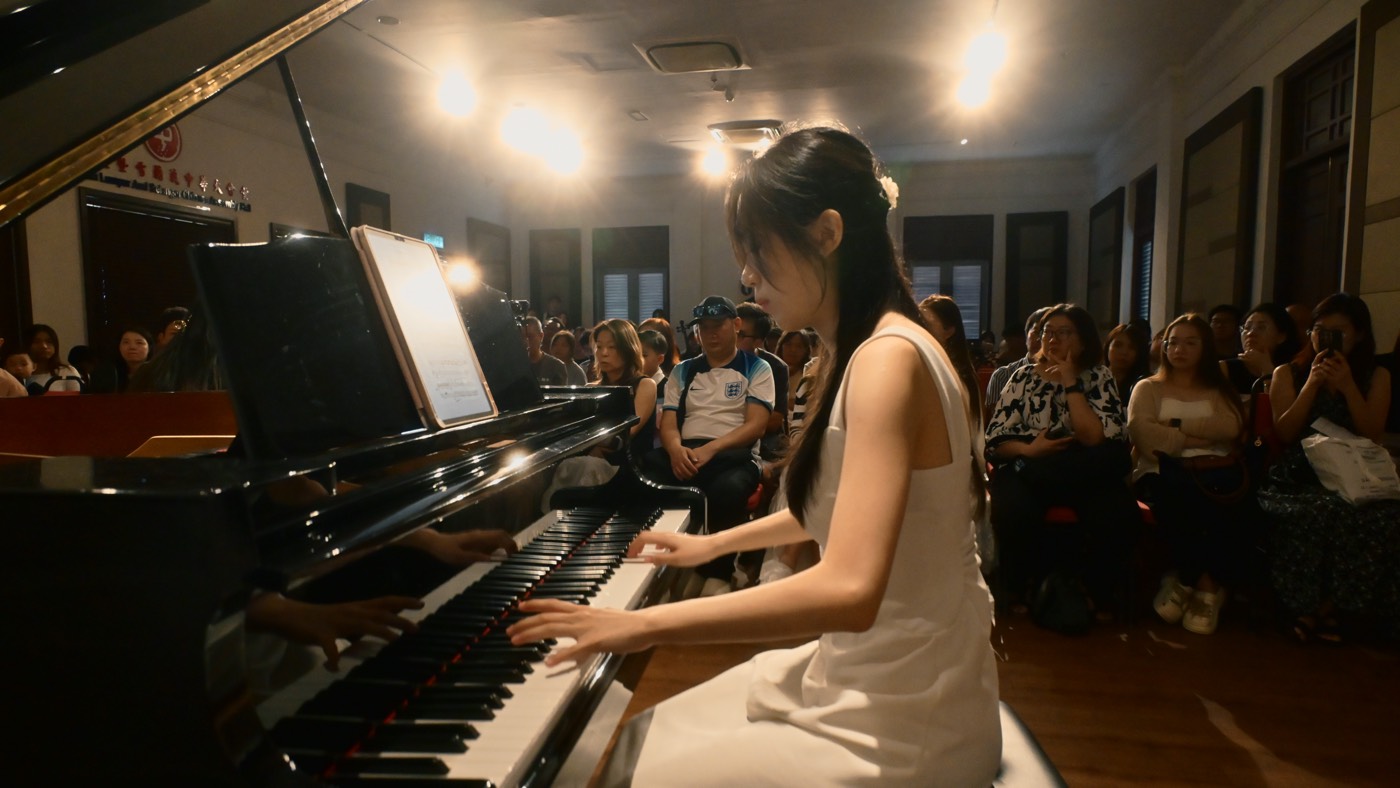
It is the first question almost every parent asks us, usually on WhatsApp, usually with a photo attached. Sometimes the child is two and already climbing onto the piano stool. Sometimes the child is nine and the parent is worried they have left it too late. Both worries are common, and both are usually misplaced.
The useful answer is not a single number. Starting age depends on the instrument — hands have to reach, arms have to hold, lungs have to fill — and on a handful of readiness signals that have nothing to do with talent. Here is how we think about it.
- Piano and ukulele from age two. Both can be played by very small hands, so they are where our youngest students begin.
- Most children start between five and seven. Reading, attention and hand size all arrive around then, which makes early progress quick.
- Readiness is behavioural, not musical. Can they attempt something, get it wrong, and try again? That matters more than any aptitude test.
- Later is not behind. Students arrive here at nine, at fifteen, at forty. The instrument does not know how old you are.
The short answer, by instrument
Every instrument has a physical floor. It is not about maturity or musicality — it is about whether a body of that size can hold the thing and make a decent sound without learning bad habits to compensate. These are the ages we start students at each of the eight instruments we teach:
| Instrument | From | Why that age |
|---|---|---|
| Piano | Age 2 | The sound is already there — press a key and it speaks. Nothing has to be held, tuned or supported. |
| Ukulele | Age 2 | Small body, soft nylon strings, four strings instead of six. The gentlest possible entry to strings. |
| Violin | Age 5 | Fractional sizes go very small, but the left arm has to hold a position that takes a little strength. |
| Guitar | Age 6 | Fingers need to reach across the fretboard and press hard enough to sound a clean note. |
| Gu Zheng 古筝 | Age 6 | Twenty-one strings across a large instrument — the reach is the limiting factor. |
| Drums | Age 7 | Four limbs, independently, on a kit sized for a body with some height and coordination. |
| Cello | Age 7 | Fractional sizing helps, but the instrument is held between the knees and needs bow-arm control. |
| Vocals | Age 8 | The voice is still developing. Formal technique too early asks a growing instrument to do adult work. |
Those are floors, not recommendations. A child who is six and desperate to play the drums is often better served starting on something they can begin now — and the technique usually transfers when they move across.
What a lesson looks like at two or three
Parents are often sceptical that a two-year-old can have a music lesson at all, and they are right to be — if what they are picturing is a scale book and a metronome. That is not what happens.
A lesson with a toddler is short, structured and playful, built around the attention span actually in the room. It works on pulse before pitch: clapping, stepping, call and response. It works on hand shape at the keyboard rather than repertoire. Most of all it builds the habit of sitting down and making a sound on purpose, which is the thing that every later skill is bolted onto.
Progress at that age is measured in months rather than weeks, and that is the point. A child who spends a year learning that music is something you do, not something that plays in the car, arrives at five ready to move quickly.
Why five to seven is the most common starting point
If we plotted our intake, this is where the peak sits — and it is not an accident. Three things converge in that window. Children start reading, which makes notation a smaller leap. They can hold attention for a half-hour lesson without it costing them anything. And their hands are finally big enough for most instruments on the list above.
The practical consequence is speed. A six-year-old beginner typically covers in one year what a three-year-old covers in two. That is not an argument against starting at three — the three-year-old arrives at six with a year of instinct the beginner does not have — but it does mean parents of five- and six-year-olds have nothing to catch up on.
Readiness is not a level a child reaches. It is a set of behaviours a teacher can work with.
Readiness is not the same as age
The birthday is the crude proxy. What a teacher actually looks for in the first lesson is narrower and more useful, and most of it is behavioural:
- They will attempt something new in front of an adult they have just met.
- They can follow a two-step instruction — put this finger here, then play it twice.
- They notice when a sound is wrong, even if they cannot yet fix it.
- They will do a thing again after getting it wrong, without the whole lesson collapsing.
- They show some interest in the instrument itself, not only in the idea of being someone who plays it.
Notice what is missing from that list: perfect pitch, a musical family, an ear for melody, sitting perfectly still. Those are either irrelevant or they are outcomes of lessons rather than entry requirements for them.
A trial lesson is one-to-one with a teacher, at Pandan Indah or Damai Perdana — long enough to see how your child responds to the instrument. Trial lesson fees apply.
Book a Trial LessonStarting later is not starting behind
The most persistent myth in music education is the closing window — the idea that a child who has not begun by seven has missed something permanent. Our students include children who started at nine and teenagers who started at fifteen, and none of them are playing catch-up in any sense they would recognise.
Older beginners bring advantages the very young simply do not have. They can practise without being supervised. They can hold an abstract idea from one week to the next. They chose this, which changes how they work. What they lose in years they recover in efficiency, often within the first eighteen months.
The same applies well past childhood. We teach adults across both branches — some who played as children and stopped, some who have never touched an instrument. We do not believe in age limits on musicianship.
What happens in a first lesson
A trial lesson runs thirty minutes, one-to-one with the teacher, at either the Pandan Indah branch or the one in Damai Perdana — families in Ampang and Taman Maluri usually find the first easier to reach, and those closer to Bandar Tun Razak the second. Trial lesson fees apply.
It is a real lesson rather than an interview. The teacher will get some sound out of the child in the first ten minutes, because that is what tells you whether the instrument has landed. Afterwards you will get an honest read on fit — including, occasionally, the advice to wait six months or to try a different instrument. That answer is more useful than a polite yes.
Come and see if it feels like home. It usually does.
Frequently asked questions
No. We teach children from age two on piano and ukulele. Lessons at that age are short, structured and playful, built around a toddler’s attention span rather than a syllabus — pulse, listening, hand shape and the habit of sitting down to make sound on purpose.
Not remotely. Seven is squarely inside the most common starting window, and a seven-year-old typically progresses faster in the first year than a three-year-old — they read sooner, retain more and can practise unsupervised. Almost nothing worth learning is closed off at seven.
Usually not. Sitting still is partly a skill that lessons build rather than a prerequisite they demand. What matters more is whether the child will attempt something, get it wrong, and try it again. If that is there, a teacher can work with it.
Piano and ukulele start from two, violin from five, guitar and gu zheng from six, drums and cello from seven, and voice from eight. Those minimums are about hands, height and lung development rather than musical ability. A trial lesson is the quickest way to check the fit.