How Virtuoso Élite know the lessons are working
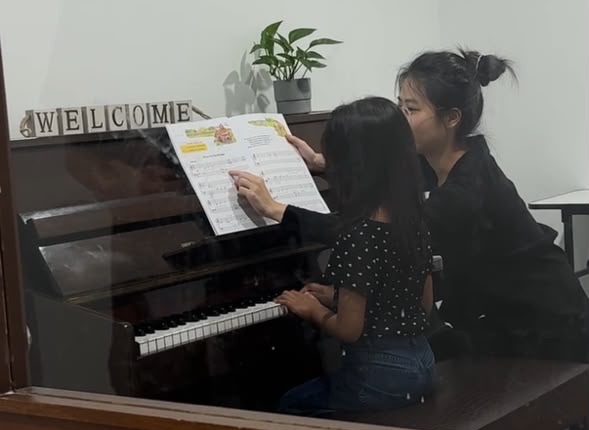
Our waiting area is a few chairs and a low table, a short walk from the classroom doors. The doors are not soundproof. That was the shape of the building rather than a design decision, and it has turned out to be the most useful thing about the place.
Here is what happens, most weeks. A parent is sitting with their phone, thirty minutes to fill, half listening to the same four bars that have been going round the house since August. Then those four bars turn into a piece of music. They stand up.
They walk to the door quietly, the way people walk when they do not want to be the reason a thing stops. Then they film it from the doorway, phone held at chest height, without saying a word.
It happens often enough that we have stopped remarking on it. Grandparents do it. Fathers who have said very little at the desk do it. And it is always set off by the same thing, a sound they were not expecting.
One evening in particular
A weekday, late, the last slot of the day. A father brought his daughter in straight from work. He had not been home. He was still in his work clothes and had the particular stillness of somebody upright since six in the morning.
He sat down. Within a few minutes he was asleep, properly asleep, head back, phone loose in his hand. I remember thinking we ought to turn the fan down.
Then his daughter started playing the piece she had been working at for weeks, the whole way through, at tempo.
He woke immediately, as though somebody had said his name, and he was smiling before his eyes were properly open. Whatever the day had put on him was gone from his face.
He got up, took out his phone, went to the door and filmed her. She saw him. She kept playing and smiled back at him, and neither of them said anything, because she was in the middle of a piece and he was not going to be the reason it stopped.
He woke to his daughter playing something she could not play three months earlier, and he was smiling before his eyes were open.
I have thought about that evening a great deal since. It is also the clearest answer to the question this article is about. Nobody had to tell that father whether the lessons were working.
What you are actually hearing
It is worth being precise about what changes, because parents often listen for the wrong thing.
New pieces are the last thing to arrive. What moves first sits underneath. The pulse steadies, so the music stops racing through the easy bars and stalling at the hard ones. The tone cleans up, with fewer scrapes on a violin and less thumping on a piano. Then the gaps close. A beginner plays a note, finds the next one, then plays it, and the finding is audible. Over a few months that searching shortens until it disappears, and a row of correct notes becomes a line of music.
That last one is what parents in the waiting area react to. They could not name it. Nobody stands up from a chair thinking about the gaps between notes. But the ear catches it at once, because a line of music and a row of correct notes do not sound alike. More on the early months in our account of the first six months of violin, and on the practice that drives it in how much a child should practise.
What it does not tell you
Three qualifications, all of them against our own interest.
A recordable moment is not proof of steady progress. What gets filmed is the piece a child has played two hundred times. It is real and it is earned, and it is also the finished end of the work.
A quiet month is not a bad month. Progress is not a slope. A child can appear to stand still while something reorganises underneath, then have a fortnight where three things arrive at once.
A child who sounds lovely may be avoiding something. It is possible to sound good from a corridor by playing only what is comfortable. A doorway cannot reveal that. A teacher can.
A trial is thirty minutes, one-to-one with the teacher, at Pandan Indah or Damai Perdana. You are welcome to wait just outside the door. Trial lesson fees apply.
Book a Trial LessonWhat we watch that you cannot hear
The waiting area gives you the headline. The rest is duller, and it is our job.
Teachers keep notes on every lesson: what was set, what came back, what has been skipped twice and why. A child who has quietly stopped practising shows up there weeks before it shows up in the sound. An unpractised week and a genuinely difficult piece sound alike from outside the door and quite different from inside it.
Beyond that there is one fixed checkpoint. Every student plays at a recital every three months, whatever their level. Playing in front of people is a harder test than playing in a lesson, and the clearest read on a term we have. We have written separately about why every student performs.
Worth stating plainly, since families sometimes assume otherwise: we do not currently enter students for graded examinations. ABRSM and Trinity preparation is coming soon, and optional when it arrives. Until then the measures are the teacher’s notes, the recital, and your own ear from a few feet away.
That last one is not a consolation prize. Parents ask us whether it is working, and they have usually answered it themselves already, on an ordinary weekday, standing in a doorway with a phone.
- Progress is audible before it is documented. Parents hear it through a classroom door months before anyone writes it down.
- Pulse and tone change first. New pieces come much later, so listening only for harder repertoire makes a good term sound flat.
- Quiet months are normal. Learning arrives in steps, and the flat stretches are usually consolidation.
- Ask the teacher. They keep notes on every lesson and can tell you what a corridor cannot.
Kuan Jea Yi, Founder, Virtuoso Élite Music Academy.
Frequently asked questions
Sooner than most parents expect, though not in the form they expect. Pulse and tone usually steady within the first two or three months, and new repertoire takes longer. If you listen only for harder pieces you will miss most of what has changed.
Yes, and parents do it often. We ask only that you film from the doorway. A child filmed at close range starts performing instead of learning, and the lesson loses its shape.
Ask the teacher, who keeps notes on every lesson and can tell you what has moved and what has not. Every student also performs at a recital every three months, which is the clearest single read on a term. Graded examination preparation is coming soon.
Yes. Progress arrives in steps, and the flat stretches are usually where consolidation happens. Mention it to the teacher anyway, because a lasting plateau and a piece pitched slightly too hard sound identical from outside the door.