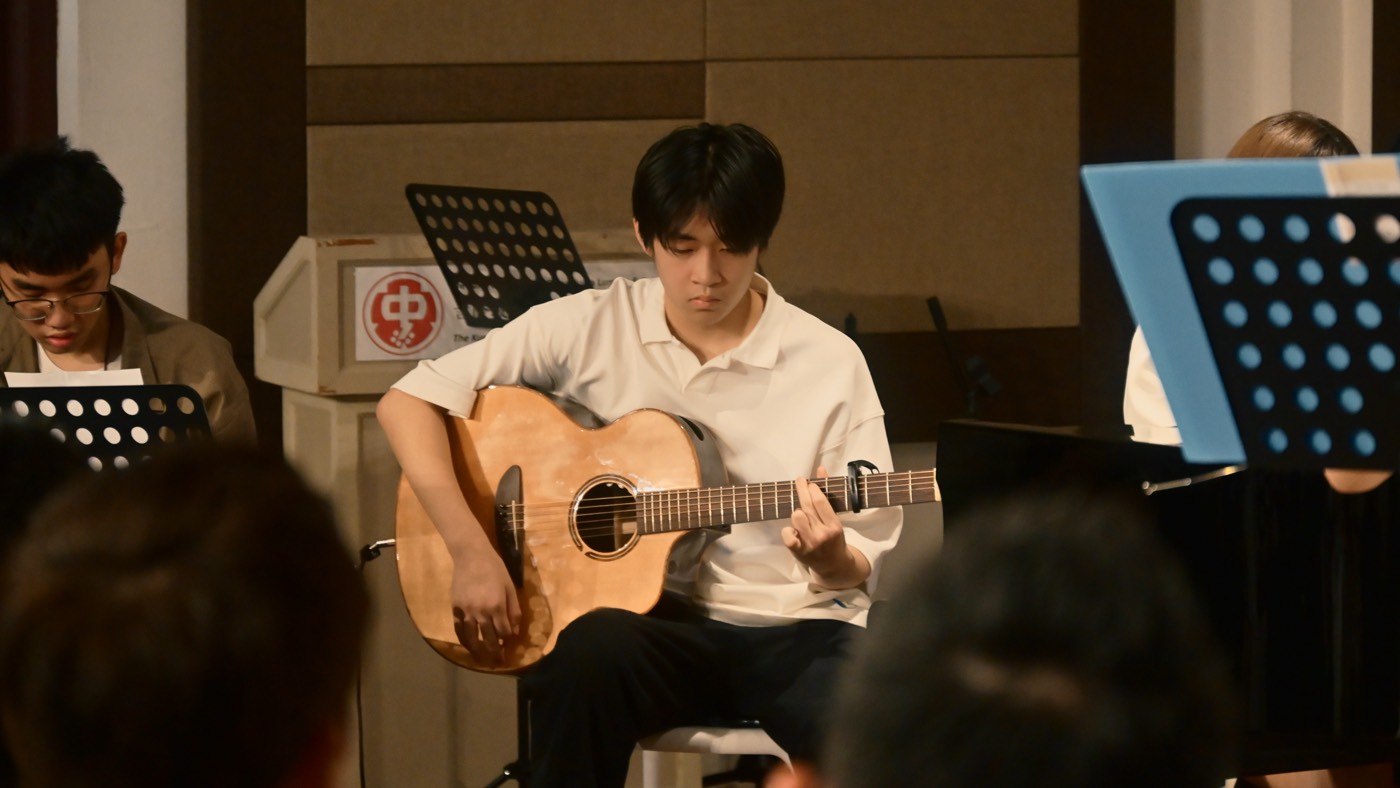
Adults arrive at a first lesson apologising. For their age, for their hands, for the fifteen years since they last touched a piano, for taking up a teacher’s time with something so obviously meant for children. Then they play something in the first half hour and the apology quietly stops.
The belief underneath the apology is that music has a closing window — that a brain past a certain age cannot learn this. It is the most durable myth in music education and it is not what happens in the room.
- Adults learn differently, not worse. Slower to build reflexes, much faster to understand structure.
- Twenty minutes most days beats two hours on Sunday. Frequency is what consolidates.
- The hardest part is not the hands. It is tolerating being a beginner at something.
- We teach adults at every level, including people who have never held an instrument.
What actually changes after childhood
Two things get harder. Physical reflexes take longer to lay down, so the sheer number of repetitions needed for a passage to become automatic goes up. And adults carry self-consciousness into a room where children carry none, which makes the first months uncomfortable in a way that has nothing to do with ability.
A great deal gets easier. An adult understands a key signature the first time it is explained. They can hold an abstract instruction across a week. They practise without being nagged, they can articulate what feels wrong, and they chose to be there — which turns out to matter enormously. Children are usually enrolled. Adults enrol themselves.
The net effect, in our experience, is that adult beginners move quickly at the start, hit the physical wall that everyone hits somewhere around the six-month mark, and then — if they keep going — pass straight through it. The ones who stop rarely stop because they could not do it.
Children are enrolled. Adults enrol themselves. That difference does more work than talent.
The closing window, examined
There is a real phenomenon behind the myth. Certain narrow abilities — absolute pitch is the usual example — do appear to be much easier to acquire very young. That is a genuine finding, and it has been stretched into a claim it never supported: that musical learning as a whole shuts down.
Almost nothing that matters in playing an instrument belongs to that category. Reading, technique, tone, phrasing, ensemble, memory, the ability to practise well — all of it remains learnable, and adults have taught themselves each of these things at every age at which anyone has bothered to look.
What genuinely separates adults who progress from adults who do not is neither age nor talent. It is whether they can be a beginner for a while without treating it as evidence about themselves.
How much practice a working week allows
The honest answer for most people in KL, between a job and a commute, is twenty minutes. That is enough, provided it happens most days.
Long weekend sessions feel productive and are the least efficient way to learn an instrument. Physical skills consolidate in the gaps between practice, not during it, so five short sessions beat one long one by a distance. Twenty minutes at the same time each day — before work, or after dinner before the evening dissolves — outperforms every ambitious schedule that collapses in week three.
- One lesson, weekly, one-to-one — the fixed point everything else hangs on.
- Twenty focused minutes on four or five other days.
- Ten of those minutes on the thing you are worst at, not the thing you enjoy playing.
- One day off, deliberately. Rest is part of the method, not a failure of it.
A trial lesson is one-to-one with a teacher, at Pandan Indah or Damai Perdana — both easy enough to reach after work, from Ampang or from Bandar Tun Razak. Trial lesson fees apply.
Book a Trial LessonWhich instrument suits an adult beginner
The instrument you actually want to hear is the right one. That sounds like a dodge and it is not — adult practice is entirely self-motivated, so wanting the sound is the fuel supply.
That said, some practical notes. The piano gives you a correct note the moment you press a key, which means you are making music in the first lesson rather than fighting for tone. The guitar gives you a recognisable song early, and beginners usually start on nylon strings, which are far kinder to untoughened fingers. Voice requires nothing to buy, carry or store. The violin and cello demand the most patience at the start and repay it with the most expressive line in the room.
And there is no rule that the instrument you played at twelve is the one you must return to. A surprising number of adult students deliberately choose something they have no history with, precisely because there is no old standard to measure themselves against.
Playing in public, at any age
Our calendar is built around the recital: every three months, students at every level perform — at the academy and at external venues — and every performer receives a VEMA Certificate of Completion. Adults take part alongside children, which the first time round sounds worse than it is.
Nobody is required to. Plenty of adult students play entirely for themselves and never set foot on a stage, and that is a complete musical life. But a deadline, a piece polished to a finish, and one nervous performance a year does more for an adult’s playing than any amount of additional practice.
Whichever you choose — come and see if it feels like home. It usually does.
Frequently asked questions
No. Our students arrive aged two and stay through working adulthood, and adult beginners are a normal part of the school rather than an exception. We do not believe in age limits on musicianship.
Twenty focused minutes on most days will move you forward steadily. Frequency matters far more than duration — five sessions of twenty minutes beats one session of two hours, because the consolidation happens between sessions rather than during them.
Piano and guitar are the most common choices, for good reasons: the piano gives you a note in tune immediately, and the guitar gives you a song early. Voice requires nothing to buy and carry. There is no wrong answer — the instrument you actually want to hear is the right one.
Only if you want to. Our recitals run every three months and adults do take part, but nothing about the lessons requires it. Plenty of adult students play entirely for themselves.