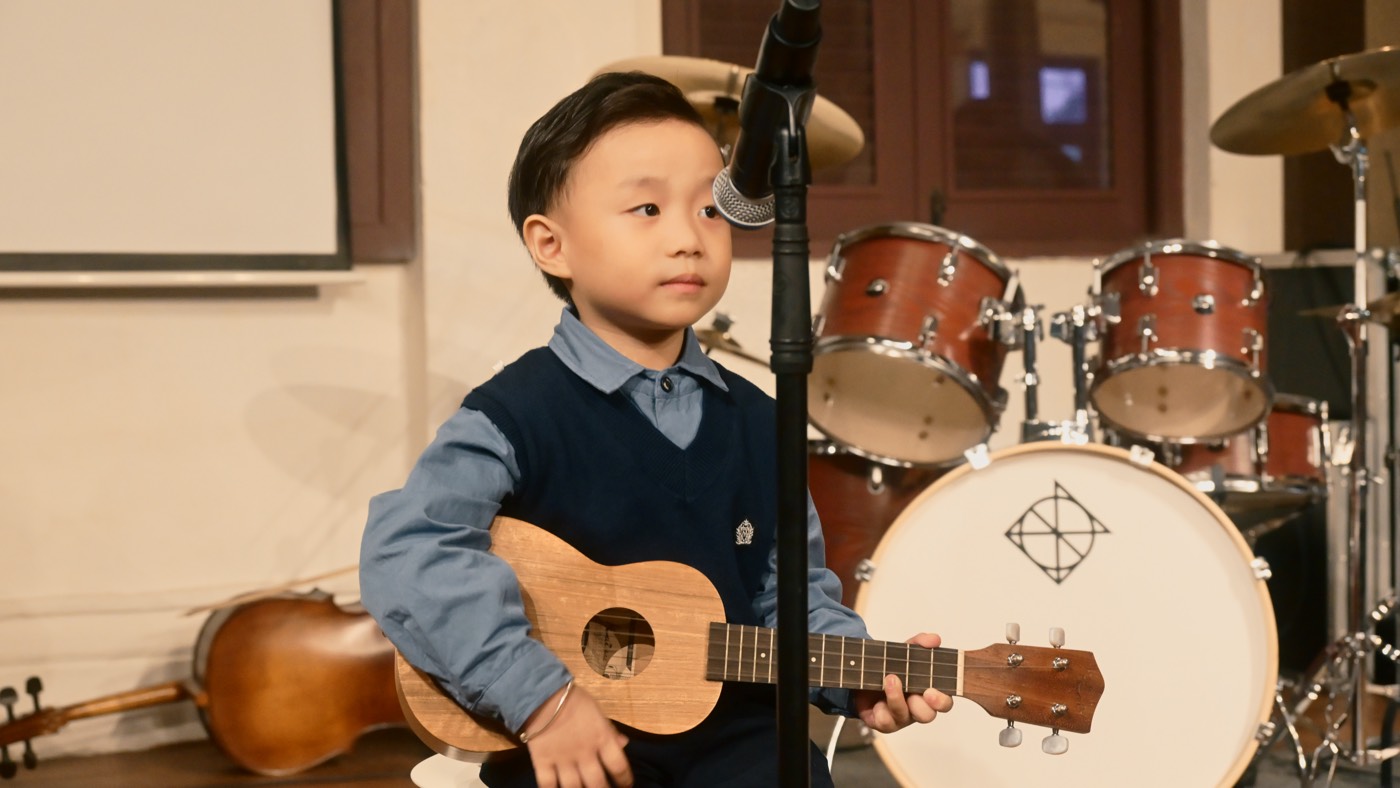
The suspicion is understandable. The ukulele is small, cheap and cheerful, it turns up in primary school music rooms, and it has four nylon strings where a guitar has six. It looks like a toy that teaches you to want a real instrument later.
Two things are true at once. It is a genuine instrument with its own repertoire and its own virtuosi, and it is also the best bridge into fretted playing that exists for a young child. Families do not have to choose which of those to believe.
- Ukulele opens at two; guitar waits until six. For a small child it is not a lesser option, it is the only fretted option.
- Four nylon strings under low tension means a child's fingertips can actually press them.
- Chord shapes transfer to the guitar almost directly, under different names.
- Plenty of students never move across, and that is a perfectly good outcome rather than an unfinished one.
Why a four-year-old can start ukulele but not guitar
The barrier to a young child on the guitar is not comprehension. It is fingertips.
Steel strings under full tension hurt to press, and the smallest hands cannot generate the force a clean note needs. Even on a nylon-strung classical guitar, a full-width neck asks a five-year-old to stretch across frets their hand does not span. The result is a child who understands exactly what is being asked and physically cannot do it, which is the most reliable way to end music lessons early.
A soprano ukulele removes every part of that. The neck is narrow, the scale is short, the strings are nylon and slack, and a first chord can be one finger on one string. A two-year-old can be shown how to strum in tune with someone else. A four-year-old can play three chords and accompany a song they know — which is, in every way that matters to a four-year-old, real music.
Soprano, concert or tenor
Sizes are not fractions here, as they are on the violin. They are named, and the differences are modest but real.
| Size | Roughly | Who it suits |
|---|---|---|
| Soprano | The traditional one, and the smallest — around 53 cm overall | Young children, and anyone who wants the bright, classic ukulele sound |
| Concert | A little larger, with more space between frets | Older children and adults, particularly if fingers feel cramped on a soprano |
| Tenor | Larger again, louder, fuller tone | Adults, and students moving toward fingerstyle playing |
| Baritone | The largest — and tuned differently from the other three | A special case; it is closer to a small guitar than to a ukulele |
The first three are tuned identically, so a student moving from soprano to concert changes nothing they know. The baritone is the exception and is worth avoiding for a beginner, because its tuning does not match what a teacher or a chord chart will assume.
For a child, start with a soprano. For an adult with large hands, a concert is usually the more comfortable purchase and costs very little more.
What transfers to the guitar, and what does not
More than most people expect. The four ukulele strings sit in the same relationship to one another as the top four strings of a guitar, which means chord shapes carry across directly — a shape a student calls a C on the ukulele becomes a G on the guitar with nothing changed but the name. A student arriving at the guitar with two years of ukulele already knows how to form and change chords, how to strum in time, and how to accompany a singer.
What does not transfer is the physical side. Six strings instead of four, steel under tension instead of nylon, a wider neck and a heavier body: the right hand adapts quickly and the left hand takes a few months to toughen. There is also a genuine gap in bass-string work, since the ukulele simply has none.
The net effect is that a ukulele student starting guitar at eight or nine tends to move through the first year in something closer to a term.
If your child is under six, the ukulele is very likely the right first instrument. Book a thirty-minute trial at Pandan Indah or Damai Perdana. Trial lesson fees apply.
Book a Trial LessonWhen to move across, and when not to
There is no fixed moment. The signals worth watching are physical and musical rather than calendar-based: hands that span the frets comfortably, a student asking for songs the ukulele cannot really carry, or an interest in the bass end of a piece.
Equally, there are good reasons to stay. The ukulele has a serious solo repertoire, a fingerstyle tradition that is genuinely demanding, and a ceiling far higher than its reputation suggests — a student can spend a decade on it without running out of things to learn. It is also the instrument most likely to be picked up casually at home, which is not a small consideration for a child who has already stopped practising one instrument.
Our position is that moving to the guitar should be a decision made because the guitar is wanted, not because the ukulele has been outgrown. Those are different reasons and they lead to different students.
What to buy, and what to avoid
The failure mode is the coloured plastic instrument sold as a toy. It will not hold tuning for a single lesson, and a child who cannot stay in tune cannot hear whether they are playing correctly — which undoes the main advantage the instrument has.
What to look for instead is modest: geared tuners rather than friction pegs, a neck that is straight when you sight down it, and strings that sit close enough to the fretboard to press without effort. A sound but unremarkable soprano from a recognised maker costs a fraction of any other instrument we teach, and is the least risky first purchase in music. Ask the teacher before buying if you are unsure; it takes thirty seconds to check an instrument and saves a term of frustration.
Frequently asked questions
It is easy to begin and not at all easy to master. Getting a first chord out takes minutes, which is exactly why it suits young children; the fingerstyle repertoire at the other end will occupy a serious student for years.
No — it usually accelerates it. The chord shapes transfer directly under different names, and the timing, strumming and accompaniment skills carry across whole. What has to be rebuilt is fingertip strength for steel strings, which takes a few months.
A soprano for a child, which is the smallest and the traditional size. Concert and tenor suit older students and adults, and are tuned identically so nothing is relearned. Avoid the baritone for a beginner — it is tuned differently from the other three.
From two, which is the earliest start we offer alongside piano. The nylon strings and short neck are what make that possible; a guitar is not realistic before about six, and often later depending on hand size.